
Where Alleghany Crime News Appears
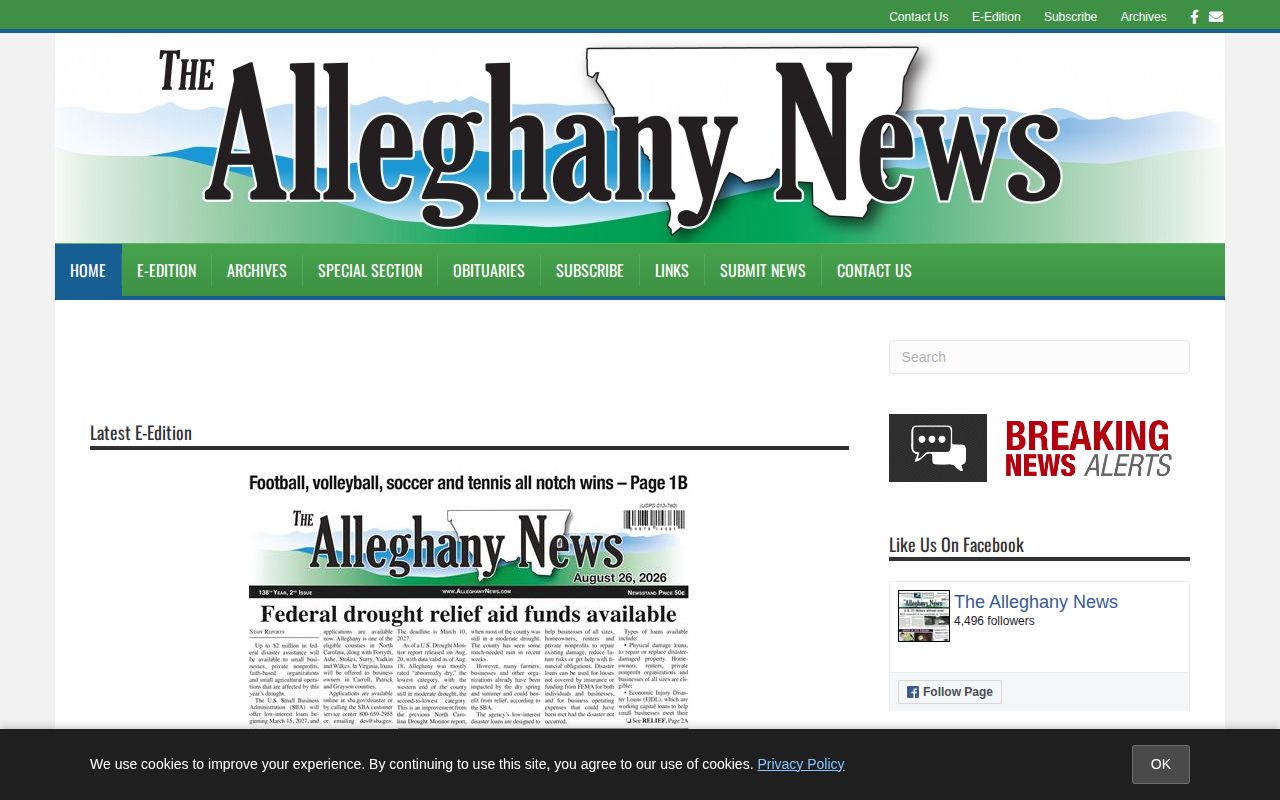
Crime coverage in this county starts with The Alleghany News. It publishes weekly on Wednesdays for local readers. But don't count on it for mugshots. The paper runs local stories, notices, and history rather than a daily arrest blotter, a booking-photo gallery, or any set photo schedule.
Regional outlets pick up stories with wider reach. WataugaOnline reported on a Blue Ridge Parkway narcotics investigation that involved the Alleghany Sheriff's Office and ended with a transfer. The Wilkes Record covered a chase connecting Alleghany and North Wilkesboro. WYFF 4 handled a Parkway traffic stop tied to drug trafficking. These are one-off reports. None works as a countywide booking feed.
The sheriff's office also posts on Facebook and YouTube, though neither channel offers a steady stream of booking photos. For the full picture, the county-wide guide shows how the sheriff page, the jail phone, the records form, and the court Portal fit together.
Outlets and Their Coverage
The table below sorts true local reporting from official statements and unofficial aggregators. "Photo" next to an outlet means an image might appear in a story or a third-party entry. It does not mean the outlet runs a current photo service for the county.
| Outlet | Coverage | Photos? | Where to look |
|---|---|---|---|
| The Alleghany News | County-local weekly, published Wednesdays | No current mugshot section verified | alleghanynews.com |
| WataugaOnline | Occasional regional law-enforcement stories | Not a recurring booking feed | Blue Ridge Parkway story |
| The Wilkes Record | Cross-county incidents and agency reporting | No fixed county photo section verified | Alleghany chase story |
| WYFF 4 | Regional television public-safety stories | News imagery, not a roster | Blue Ridge Parkway report |
| Sheriff social channels | Official announcements and community information | Not verified as booking feeds | Facebook and YouTube |
| Mugshots.com | Historical unofficial county route | Some records, plus missing-photo labels | Alleghany County page |
| Busted Newspaper | Likely county route, access failed during sweep | Recheck before relying on it | Possible county route |
| RecentlyBooked | State directory, no Alleghany section found | Not established locally | North Carolina directory |
| Arrests.org and Mugshots.zone | No verified Alleghany route found | Not established locally | Arrests.org and Mugshots.zone |
How Busted Photos Reach News
How does a busted photo end up in print? A newsroom might work from a sheriff's statement, a police report, a public-records request, or someone who sat through a hearing. There's no sign that Alleghany County hands every booking photo to the media on its own. The sheriff's site confirms the jail's role but posts no image policy and no daily photo feed.
North Carolina law shapes what gets released. G.S. 132-1 sets the broad public-record framework. G.S. 132-1.4 splits basic arrest information from criminal-investigation records, and G.S. 132-6 covers inspection, copies, purpose, and which material can be separated out for release. A photo can exist and still stay off the agency's website and out of the newspaper.
No North Carolina law bans pay-to-remove mugshot sites. Bills have been proposed, but proposals aren't statutes. Where a private site offers a free correction or removal path, follow its written policy and bring court paperwork. And remember that a news article is editorial content, so it can stay online long after a case moves on.
From a Story to the Official Record
A story becomes far more useful once it names the arresting agency or the detention center. That's your entry point. The article itself is just a lead, not the record. Build the trail in this order:
- Save the story URL, publication date, person’s name as printed, agency, alleged charge, and facility.
- Call the Alleghany County Detention Center at 336-372-4455 to ask about current county custody, release, or transfer. Do not treat the article date as booking time.
- Use the county’s signed public-record request form for a booking entry and any releasable photo.
- Search the NC eCourts Portal with Alleghany County filters and the person’s name.
- Compare the docketed charge, hearing events, and disposition with the story. Contact the clerk at 336-372-3900 for an official copy.
The court disposition, not the article, tells you how a case resolved. Reporters write about arrests. Dockets track outcomes. For that next step, the Portal is the place to look.
Stories out of Sparta have one extra stop. The town police page lists 336-372-4252, but its public database covers crash reports only, not arrests. So even town-level coverage loops back to the county jail and the county's records request process.
Why a Regional Story May Show a Transfer
The WataugaOnline Parkway story shows a records puzzle worth understanding. An investigation in Alleghany led to booking at the Alleghany County Detention Center, followed by a move to Ashe County Detention Center under a different bond figure. Small wonder a story, a phone call, and a later custody check can name three different facilities.
To sort it out, ask three questions. Which agency made the arrest? Which facility held the person at the time? Which court carries the case? The Sparta guide handles town arrests, while the official county sources cover the rest of the record path.
Read the Date Before the Headline
Check the date before you trust the headline. News sites show publication dates, update stamps, or syndicated timestamps. None of them guarantees the booking date. Someone in an article may have been booked days earlier, released, or transferred by the time you read it. Keep the story date handy. Then ask the detention center what custody date it can confirm.
The county's request form lets you describe a date-bounded record and pick email, mail, or pickup for delivery. No flat photo fee or response time has been published. Ask about current cost and timing when you submit. That keeps the news lead separate from the official record without losing the useful local reporting.
Older Stories and Local History
Sparta's newspaper history runs deep. DigitalNC holds digitized issues of the Alleghany News and the Star-Times, plus other regional papers. Those old pages are a goldmine for tracing how a story was first reported. What they are not is a live booking roster. A photo printed on newsprint belongs to the story it illustrated. Treating it like an official jail mugshot mislabels it entirely.
Older cases take a few sources lined up together. Check the court docket, follow the county's records process, and look at the State Archives retention schedule. Under that schedule, identification photos kept outside a case file are destroyed after three years. Photos filed with a case stick around as long as the case record does. None of those rules bind a private news site, though. Its archive is its own affair.
When the Record Changes
Outcomes shift. Charges get dropped, reduced, or erased, and verdicts come back not guilty, yet the articles and private indexes built around the original arrest often stay frozen in place. So hold onto the official court document. Then send the publisher a correction request that names exactly what needs fixing. If the page itself vanishes or gets rewritten, chase the stale snippet through the search engine's outdated-content process.
Know what each fix actually touches. A news correction edits an article, nothing more. A search-result refresh clears a cached snippet. Neither one moves the docket itself. For the true account of a county record, the court and the county clerk remain the final word, anchored to whatever date, agency, and outcome the paperwork can verify.